
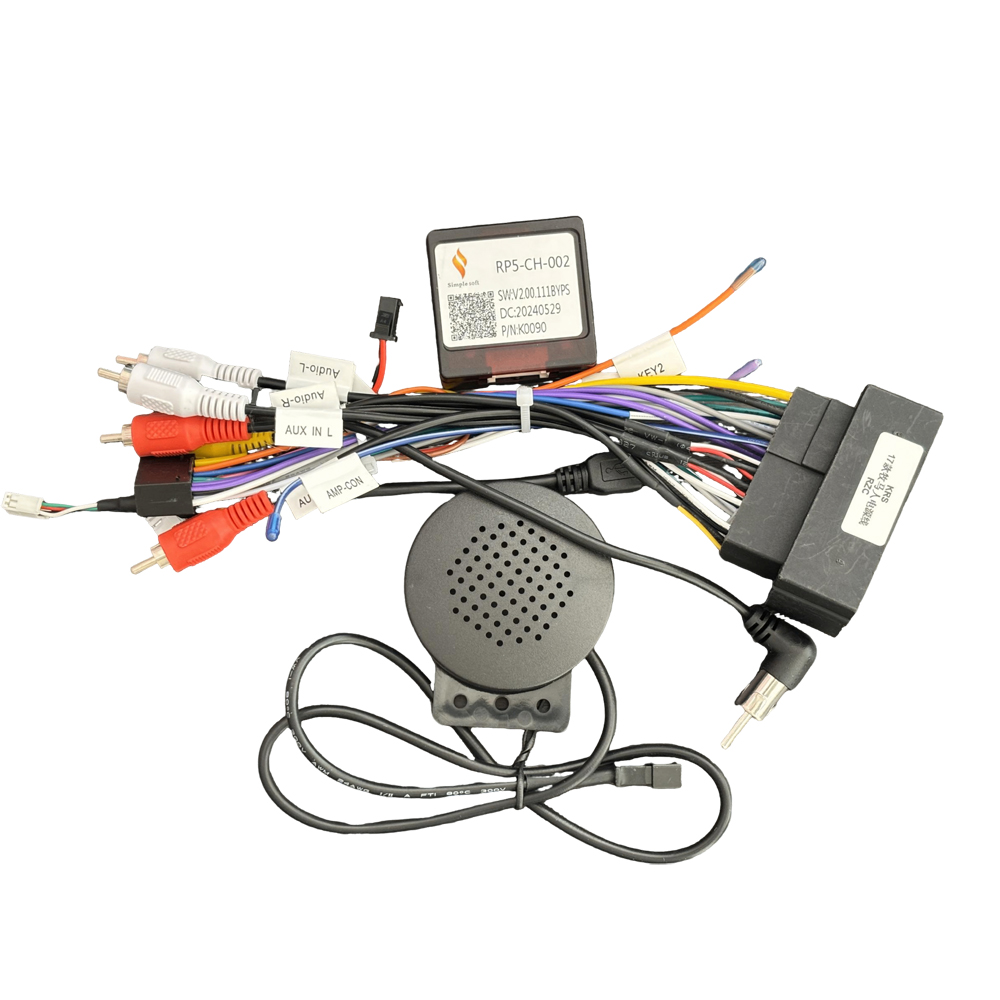
In the automotive aftermarket, upgrading to an Android head unit remains one of the most popular retrofits. With the widespread adoption of wireless Apple CarPlay, Android Auto, 360° panoramic cameras, and complex CANbus protocol boxes, head units now demand unprecedented stability in both data transmission and power delivery.
However, when sourcing or customizing navigation wiring harnesses, many overseas buyers (such as Amazon top sellers and brand distributors) often fall into a misconception: “Isn’t bare copper the best for electrical conductivity? Why do high-end factories use silver-white tinned copper wire cores instead?”
As a professional automotive wire assembly manufacturer, we will deep dive into the real-world differences between tinned copper and bare copper in the car navigation field to help supply chain decision-makers choose the right solution and eliminate product return rates.
1. What Are Bare Copper and Tinned Copper?
Before examining their impact on car stereo performance, let’s clear up the basic materials definitions:
Bare Copper: Refers to pure oxygen-free copper (OFC) wire that is directly drawn without any surface chemical treatment. It displays a natural reddish-gold color, offering extremely high conductivity at an excellent price point.
Tinned Copper: This is pure oxygen-free copper coated with an ultra-thin layer of metallic tin through a hot-dip or electroplating process. Because tin is silver-white, these wires are often called “white wires” or “tinned wires” in the industry.
2. Head-to-Head Comparison in Car Navigation Field
The space behind a car dashboard is a confined, sealed, and extreme micro-environment. Here is how both materials perform in this specific scenario:
| Feature | Bare Copper Harness | Tinned Copper Harness |
| Oxidation & Corrosion Resistance | Poor. Extremely prone to oxidation when exposed to hot, humid air behind the dash, quickly turning black or growing green “verdigris.” | Excellent. The tin layer acts as a shield, completely blocking oxygen and moisture. It never oxidizes in harsh conditions. |
| Thermal Stability | Moderate. When cars sit under direct sunlight in summer, dash temperatures can exceed 80°C. This extreme heat multiplies bare copper’s oxidation rate. | Premium. Fully complies with automotive-grade criteria. Physical and electrical properties remain 100% stable under long-term high heat. |
| Signal Quality Long-Term | Good initially. However, the resulting layer of copper oxide over time creates high resistance, leading to digital signal degradation. | Flawless & Stable. Due to zero oxidation, impedance remains consistently low, ensuring high-frequency data runs smoothly without packet loss. |
| Factory Solderability | Time-sensitive. If the wire surface oxidizes slightly during storage, soldering it onto CANbus terminals becomes difficult, causing cold solder joints. | Effortless Solder. Since the surface is already tin, it fuses seamlessly with solder wire, ensuring robust joints and lowering factory RMA rates. |
| Material Cost | Baseline cost. Requires fewer processing steps, offering a slight price advantage for ultra-low-budget projects. | Slightly higher cost due to the advanced tinning equipment and the material premium of metallic tin. |
3. Why High-End Android Head Units Demand Tinned Copper
Let’s translate these physical properties into real-world driving and customer feedback benefits:
A. Ending the “CarPlay Disconnect” Nightmare
Modern Android car stereos are no longer just basic radios; they transfer massive high-frequency data packets for wireless CarPlay, 360-degree HD video streams, and real-time CANbus vehicle data. If bare copper is used, microscopic oxidation at the pins will instantly trigger signal wave distortion. This is the root cause of the most common 1-star reviews on Amazon: “CarPlay keeps dropping connections after 6 months,” “reversing screen shows rolling lines,” or “black screen glitches.” Tinned copper’s permanent zero-oxidation ensures lag-free, rock-solid data streaming for years.
B. Defeating Dashboard “Heat and Humidity”
When a vehicle is parked under the sun, the dash area trapped inside becomes a sweatbox—reaching up to 80-90°C, combined with moisture from A/C condensation. Bare copper degrades heavily under these conditions, increasing resistance, creating heat, and in worst-case scenarios, causing short circuits. Tinned copper provides your head units with a robust 5-to-10-year electrical lifespan guarantee.
🚨 Supply Chain Insight: The True Cost of Cheap Wires
Many cross-border e-commerce sellers try to save 10 to 20 cents per harness kit by picking low-cost bare copper or even Copper-Clad Aluminum (CCA) suppliers. However, when listings get destroyed by a wave of 1-star reviews due to oxidized, failed cables 4 months later, they lose thousands of dollars in ranking and inventory. Gambling a $300 high-end Android head unit brand reputation over a 20-cent wiring harness shortcut is a dangerous business decision.
4. How Buyers Can Verify Wire Material (Anti-Fraud Guide)
When auditing wire harness factories, global buyers can use these three simple steps:
The Visual Test: Strip the outer insulation jacket. Bare copper is distinctively reddish-gold; tinned copper is bright shiny silver.
The Scrape Test: Use a small blade to gently scrape the silver wire core. If it reveals red copper inside, it is authentic tinned copper. If the core remains dull grey-white, beware—it is likely cheap Copper-Clad Aluminum (CCA) or aluminum wire.
Certification Check: A reputable automotive-grade wire factory should easily provide RoHS certifications, CE certificates, and oxygen-free copper purity test logs.
Partner with a Premium Android Navigation Harness Factory
We are a dedicated automotive wiring harness factory specializing in Android head unit cables, custom power harnesses, CANbus protocol boxes, and car modification wire assemblies.
100% Tinned Copper Conductors: We refuse to cut corners. All critical signal and power lines utilize premium tinned copper to protect your device from oxidation and signal drops.
Fully Automated Production: Utilizing automated crimping and 100% electrical continuity testing benches, keeping our product defect rate (RMA) below 0.1%.
OEM/ODM Capabilities: Tailored plug-and-play kits for global car makes (Toyota, Honda, Volkswagen, Ford, BMW, etc.) with low MOQs and rapid prototyping.
Want to eliminate cable-related customer complaints for good? Contact us today for a free catalog, technical drawings, and bulk wholesale samples!